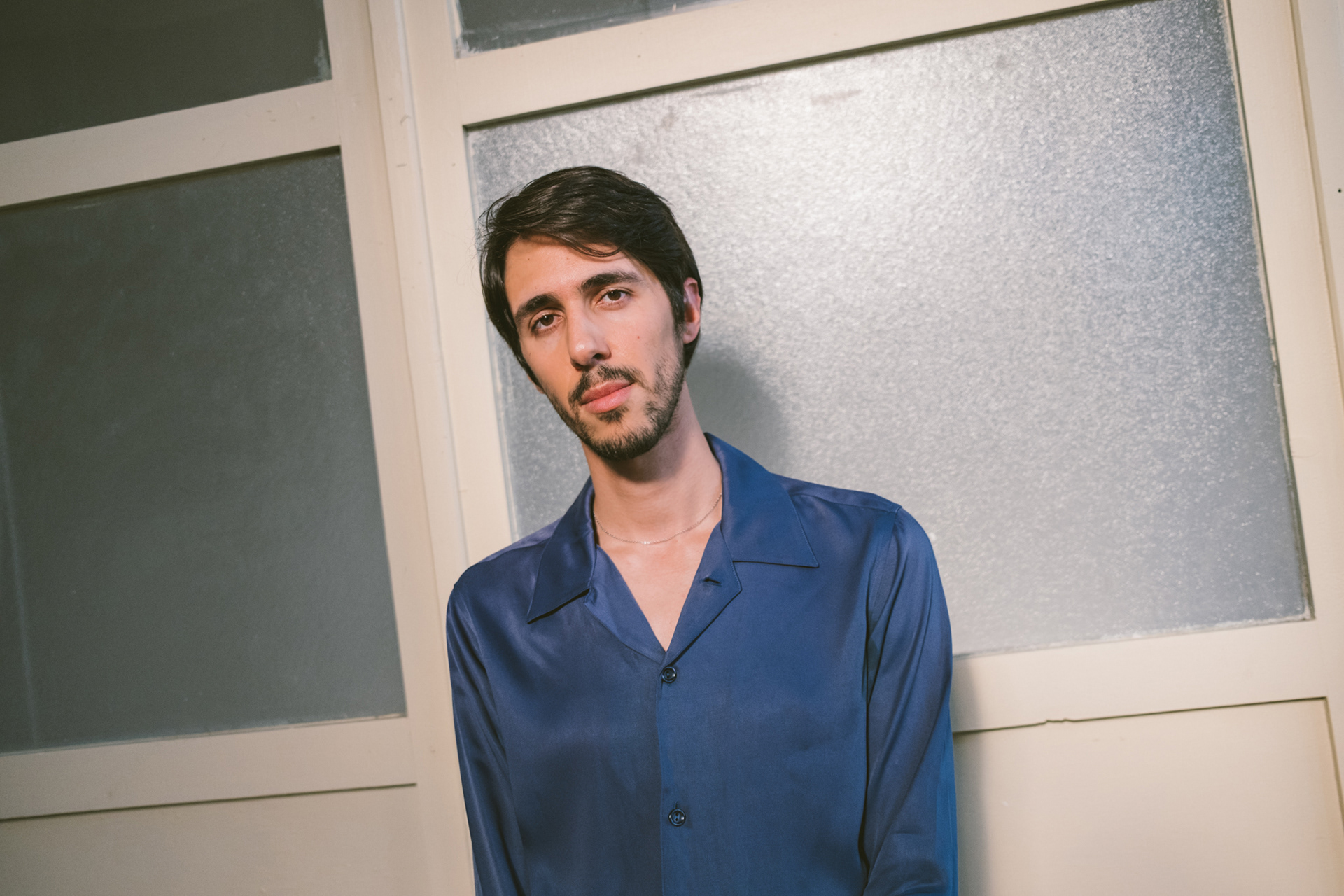
Javier Estupiñán (Canarias) es un artista audiovisual cuyo enfoque artístico se entrelaza con la investigación y la curaduría. Su práctica a menudo profundiza en pasados posibles, especulando mediante ejercicios y gestos con los que busca recuperar memorias que han sido marginadas u ocultas. Su obra construye espacios entre lo vivo y lo muerto, lo personal y lo colectivo, a través de un enfoque transdisciplinar que enfatiza el diálogo continuo entre imagen y sonido e incorpora a menudo el uso de material de archivo y animación digital. Desde 2022 co-dirige Vega de Agua, una iniciativa que desarrolla residencias artísticas en Canarias y otros proyectos culturales centrados en prácticas colectivas y multidisciplinares. Actualmente co-dirige la Otra-Escuela de Curaduría de Canarias y la Muestra de Cine Experimental Vega de Agua.
La estructura formal de sus piezas se nutre frecuentemente de diferentes estados alterados de consciencia - creación artística, sueños, meditación, contemplación, trance, entre otros -, así como de emociones y de experiencias tanto corporales como psicológicas, normalmente vinculadas a la memoria. Operan como mecanismos que intentan disolver formalmente los límites del yo, así como subvertir la cronología lineal occidental, representando el tiempo como una magnitud que se pliega sobre sí misma, donde pasado, presente y futuro se entrelazan.
En los últimos años, su investigación artística ha derivado en la creación de ensayos audiovisuales performativos, que amplían el formato audiovisual hacia una oralidad que activa las piezas. La lectura dramatizada de documentos históricos, en conjunto con la dimensión sonora y una imagen que entremezcla materiales de diversos tipos - como obras de arte, cartografías, testimonios de la Inquisición, entre otros -, le permite asumir formas artísticas vinculadas con la mediumnidad para ofrecer una corporalidad simbólica a las personas que fueron históricamente excluidas de la construcción del archivo.
Su formación académica abarca diversas disciplinas, incluyendo Comunicación, Idiomas y Educación. Ha recibido la Global Slavery History Fellowship, Ámsterdam (2024), una beca de investigación y creación sobre la historia de la esclavitud que le permitió colaborar con instituciones como el IISH (Instituto Internacional de Historia Social), el Museo de Ámsterdam y el Rijksmuseum (Museo Nacional de Ámsterdam), entre otras. Ha participado en residencias de arte en MeetFactory, Praga (2024) y en el Yermilov Center de Kharkiv, Ucrania (2019) y, a través del programa europeo Archipel.eu, fue seleccionado para desarrollar una investigación en São Miguel, Azores, gracias a una invitación del festival de arte Walk&Talk (2022). Recientemente ha formado parte del proyecto internacional Reframing Colonial Legacies (2025-2026), co-organizado entre la Universidad Zeppelin (Alemania) y la Universidad de Cape Coast (Ghana).
Javier Estupiñán (Canary Islands) is an audiovisual artist whose artistic approach is intertwined with research and curatorial practices. His works often delve into possible pasts, speculating through exercises and gestures in order to recover memories that have been marginalized or hidden. His work builds spaces between the living and the dead, the personal and the collective, through a transdisciplinary approach that emphasizes the continuous dialogue between image and sound, and often incorporates the use of archival material and digital animation. Since 2022, he has co-directed Vega de Agua, an initiative that develops artistic residencies in the Canary Islands as well as other cultural projects focused on collective and multidisciplinary practices. He currently co-directs the Otra-Escuela de Curaduría de Canarias (Other-School of Curating of the Canary Islands) as well as the Vega de Agua Experimental Film Showcase.
The formal structure of his pieces is frequently nourished by different altered states of consciousness - artistic creation, dreams, meditation, contemplation, trance, among others - as well as by emotions and both bodily and psychological experiences, generally tied to memory. They function as mechanisms that attempt to formally dissolve the boundaries of the self, as well as to subvert Western linear chronology, representing time as a magnitude that folds in on itself, where past, present, and future intertwine.
In recent years, his artistic research has led to the creation of performative audiovisual essays, which extend the audiovisual format toward an orality that activates the pieces. The dramatized reading of historical documents, together with the sonic dimension and an image that interweaves materials of various kinds - including artworks and cartographies, among others - allows him to take on artistic forms linked to mediumship in order to offer a symbolic corporeality to those who were historically excluded from the construction of the archive.
His academic background spans several disciplines, including Communication, Languages, and Education. He received the Global Slavery History Fellowship, Amsterdam (2024), a research and creation fellowship on the history of slavery that allowed him to collaborate with institutions such as the IISH (International Institute of Social History), the Amsterdam Museum, and the Rijksmuseum, among others. He has taken part in artist residencies at MeetFactory, Prague (2024) and the Yermilov Center in Kharkiv, Ukraine (2019), and, through the European Archipel.eu program, was selected to develop research in São Miguel, Azores, following an invitation from the Walk&Talk Art Festival (2022). He recently took part in the international project Reframing Colonial Legacies (2025–2026), co-organized by Zeppelin University (Germany) and the University of Cape Coast (Ghana).